İngilizce Bölüm 1 | "Be" Fiili ve Geniş Zaman
İngilizce'de Adım Adım İlerleme
BTK Akademi İngilizce Dil serisi notları.
Başlarken
Bu dil serisi ile beraber BTK akadiden takip ettiğim ingilizce dersinden aldığım notları işleyeceğim.
Be Fiili
Be fiili ingilizce de olmak anlamlamında kullanılan fiildir. Bu fiili geniş zamanda kullanımı “Ben mühendisim.” gibi anlamlar katmaktadır. “Be” fiili kişi çekimlerine göre değişmektedir.
| Kişi | Çekim |
|---|---|
| I | am |
| He / She / It | is |
| You / We / They | are |
Bu fiil peşine isimler almaktadır. Örneğin; aşçı(chef), doktor(doctor), dil(language), hayvan(animal), aslan (leon), Selçuk vb. pek çok isim sıralaya biliriz. Örnek kullanım incelemek istersek.
I am Selçuk.
You are a doctor.
He is an engineer.
She is a nurse.
It is a leon.
We are student.
You are my classmates.
They are good neighbors.
Olumsuz cümlede formu:
Kişi + am / is / are not ('m not, isn't / 's not, aren't / 're not) + İsim(Noun)
İngilizcede genel cümle yapısı;
Özne(subject) + Yüklem(Verb) + Nesne(Object)
SVO şeklindedir. Bu yapı korunduğu şekliyle genişleyecekti.
Daha detaylı anlatım sunmadan önce geniş zaman yapısını da inceleyelim.
Geniş Zaman (Simple Present)
Geniş zaman, Türkçede genel gerçekleri, alışkanlşıkları, rutinleri ve değişmeyen durumları ifade etmede kullanılır. Bu türkçede -r / -ar / -er yapısında kullanılır. Yardımcı fiili ise “Do / Does”dır.
| Kişi | Çekim |
|---|---|
| I / You / We / They | do |
| He / She / It | does |
Olumlu cümlede formu:
Subject + Auxiliary Verb (Yardımcı fiil) + Verb,
Kişi + do / does + Fiil
ÖNEMLİ! Geniş zamanda DO ve DOES yardımcı fiili olumlu cümlelerde düşer. Ayrıce does fiilindeki “s” eki fiile transfer edilir. Örneğin;
I wake up early every day.
She goes to school every weekday.
Olumsuz cümlede formu:
Kişi + do / does not (don't / doesn't) + Verb
Soru cümlede formu:
Do / Does + Kişi + Verb ?
Örnek Cümlerler:
I wake up early.
(Erken uyanırım.)

I drink coffee in the morning.
(Sabahları kahve içerim.)

You work hard.
(Çok çalışırsın.)

We study English every day.
(Her gün İngilizce çalışırız.)

They live in Ankara.
(Ankara’da yaşarlar.)

He goes to work at 9.
(O, işe 9’da gider.)

She likes music.
(O, müzik sever.)

He plays football on weekends.
(O, hafta sonları futbol oynar.)

She does not smoke.
(O, sigara içmez.)

Do you like tea?
(Çayı sever misin?)
Be Fiili ile Örnek Cümlerler:
I am a student.
(Ben bir öğrenciyim.)

I am at home.
(Evdeyim.)

You are my friend.
(Sen benim arkadaşımsın.)

You are very kind.
(Sen çok naziksin.)

He is a teacher.
(O bir öğretmen.)

She is tired today.
(O bugün yorgun.)

It is cold outside.
(Dışarısı soğuk.)

We are ready.
(Hazırız.)

They are happy now.
(Şu an mutlular.)

I am not busy.
(Meşgul değilim.)
Örnek Paragraf:
I am a student and I live in Ankara. I am 22 years old and I am very interested in technology. Every day, I wake up early and I study English at home. My classes are in the morning, so I go to school at 9 o’clock. My teachers are kind and my classmates are friendly. After school, I usually study on my computer and I read simple English texts. In the evening, I am tired but happy. I do not work at night, and I go to bed early. On weekends, I am at home and I spend time with my family. I like learning English because it is important for my future.
Kişi Zamirleri (Subject Pronouns)
| Zamir | Karşılığı |
|---|---|
| I | Ben |
| You | sen |
| He | O (Eril) |
| She | O (Dişil) |
| It | O (Cansız, Hayvan) |
| We | Biz |
| You | Siz |
| They | Onlar |
Sıfatlarla Be Fiili
Adjective(Sıfat) + Noun
| Adjective | Noun |
|---|---|
| nice | car |
| small | town |
| importent | books |
| good | men |
| tall | tree |
| old | house |
| critical | error |
Örnekler:
- I am hard working
- My sister is young
- Pets are cute
- This table is raund
- A scientist is inteliligent
- Teachers are helpfull
Be Fiili ile Konum Bildirme
| Kelime | Açıklamaı |
|---|---|
| here | burada |
| there | orada |
| over there | tam orada |
| inside | içeride |
| outside | dışarıda |
| upstairs | üst katta |
| downstairs | alt katta |
| downtown | şehir merkezi |
Bu liste yalın haliye kullanılabilir.
I'm here.
| Kelime | Açıklamaı |
|---|---|
| in | içinde |
| on | üzerinde |
| at | -da / -de |
| next to | bitişiğinde |
| beside | yakınında / bitişiğinde |
| near | yakınında |
| inside | içinde |
| outside | dışında |
| above | yukarısında / üstünde |
| belowe | aşağasında |
| under | altında |
| in front of | önünde |
| behind | arkasında |
| berween | iki şey arasında |
Bu listede sonuna işaret edebileceği kelimeler alır.
My father is in the library now.The post office is next to the bank.
Yaygın kullanımlar:
- in Turkiye
- in London
- in the house
- at home
- at work
- at the bus stop
- on the bus
İyelik Sıfatları (Possasive Adjectives)
| Subject Pronouns | Possasive Adjectives | Açıklaması |
|---|---|---|
| I | My | Benim |
| You | Your | Senin |
| He | His | Onun |
| She | Her | Onun |
| It | Its | Onun |
| We | Our | Bizim |
| You | Your | Sizin |
| They | Their | Onların |
Those books are their books
DİKKAT! Bu taloda yer alan iyelik sıfatları tek başlarına kullanılamazlar. Her zaman;
My pen
Your sister
His friends
Her mother
Its toy
Our home
Their books
vb. şekillerde kullanılırlar.
İşaret Sıfatları
| Kelime | Anlamı |
|---|---|
| This | Bu |
| These | Bunlar |
| That | Şu / O |
| Those | Şunlar / Onlar |
This bookBu kitapThese booksBunlar kitapThat bookŞu kitapThose booksŞunlar kitap
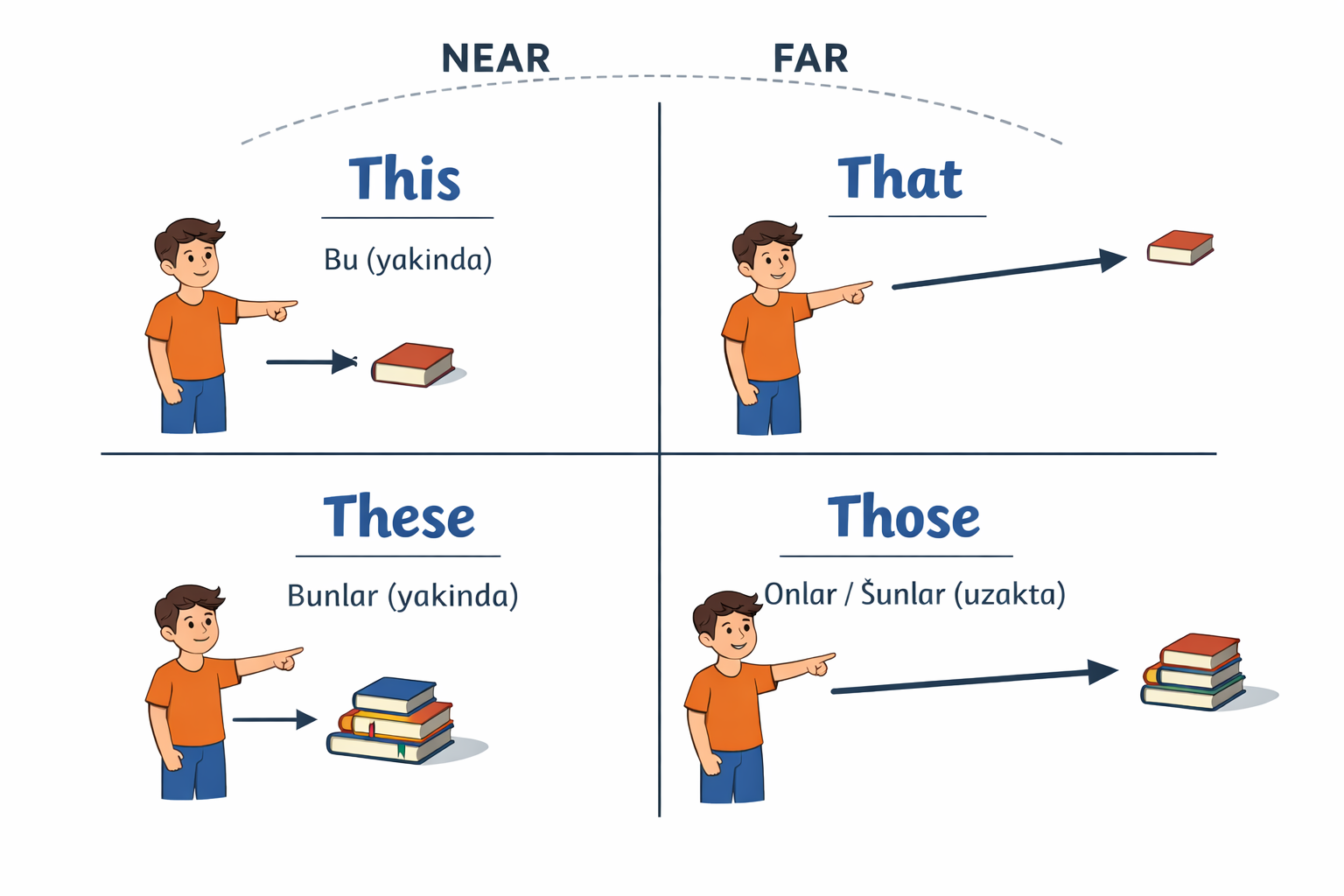
CAPTION İşaret Sıfatları 1
Sayılar
| one | two | three | four | five |
| six | seven | eight | nine | ten |
| eleven | twelve | thirteen | forteen | fifteen |
| sixteen | seventeen | eighteen | nineteen | twenty |
| ten | twenty | thirty | forty | fifty |
| sixty | seventy | eighty | ninety | a/one hundred |
| ten | one hundred | one thousand | ten thousand | one hundred thousand |
| one milion | ten milion | one hundred milion | one billion | one hundred billion |
126 789 123 : One hundred twenty-six million seven hundred eighty-nine thousand one hundred twenty-three
Saatler
What time is it?
- 4:30 : It is</span> half past four
- 4:30 : It is four thirty
- 3:15 : It’s quarter past three
- 3:15 : It’s three fifteen
- 5:45 : It is quarter to six
- 5:45 : It’s five forty five
- 9:28 : It is twenty eigth past nine
- 9:28 : It is nine twenty eight
- 11:57 : It is three to twelve
- 11:57 : It is eleven fifty seven
What time do you get home? -> At Nine p.m.
Saat ifadeleri at ile kullanılır.
- A.M. : Öğlenen önce
- P.M. : Öğlenen Sonra
Günler, Aylar , Yıl İfadeleri
What day is it?
- It is Monday
- It is Tuesday
- It is Wednesday
- It is Thursday
- It is Friday
- It is Saturday
- It is Sunday
The release of the software is on Monday.
Gün ifadeleri on ile kullanılır.
What month is it?
- It is January
- It is February
- It is March
- It is April
- It is May
- It is June
- It is July
- It is August
- It is September
- It is October
- It is November
- It is December
The midterm exams are in November.
Ay ifadeleri in ile kullanılır.
What year is it?
Our graduation is in 2025.
Yıl ifadeleri in ile kullanılır.
Bu kullanımları incelediğimizde bir çizelge ile göstermek gerekirse;
graph TD
    A[Year<br/>in 2025] --> B[Month<br/>in November]
    B --> C[Day<br/>on Monday]
    C --> D[Specific Time<br/>at 4:30 p.m.]
    D --> E[Exact Moment<br/>at midnight]

    %% Stil Atamaları
    class A rootNode
    class B warningNode
    class C successNode
    class D infoNode
    class E errorNode
Sıra Sayıları
- \(1^{st}\) : first
- \(2^{nd}\) : second
- \(3^{rd}\) : third
- \(4^{th}\) : fourth
- \(5^{th}\) : fifth
- \(10^{th}\) : tenth
- \(11^{th}\) : eleventh
- \(12^{th}\) : twelfth
- \(13^{th}\) : thirteenth
- \(14^{th}\) : fourteenth
- \(15^{th}\) : fifteenth
- \(20^{th}\) : twentieth
- \(21^{st}\) : twenty-first
- \(22^{nd}\) : twenty-second
- \(23^{rd}\) : twenty-third
- \(24^{th}\) : twenty-fourth
- \(25^{th}\) : twenty-fifth
- \(21^{st}\) : twenty-first
- \(22^{nd}\) : twenty-second
- \(23^{td}\) : twenty-third
- \(31^{st}\) : thirty-first
Sonu 1, 2, 3 ile bitenler özel (11, 12, 13 hariç).
BİLGİLENDİRME! Eğer bir tarih içerisinde gün belirtilirse on kullanılır.
The stores are closed on the \(1^{st}\) of January.
Sıklık Zarfları
| Kelime | Anlamı |
|---|---|
| Always | Her zaman |
| Usually | Genellikle |
| Often | Sıklıkla / Sık sık |
| Sometimes | bazen |
| Seldom | Seyrek / nadiren |
| Rearely | Nadiren |
| Never | Asla |
Cümlede yapısı;
Özne + Yardımcı Fiil + Sıklık Zarfları + Fiil
- I always wake up early.
- She usually drinks tea in the morning.
- He often studies English at home.
- We sometimes watch TV in the evening.
- I seldom eat fast food.
- He rarely goes out at night.
- They never smoke.
- I am always on time.
- She is usually very calm.
- They are never late.
Yes / No Questions (Evet / Hayır Soruları)
Yes / No soruları, cevabı Yes veya No olan sorulardır. Bu sorular yardımcı fiil (do / does) veya be fiili (am / is / are) başa alınarak oluşturulur.
Be Fiili ile Yes / No Questions
Yapı:
Am / Is / Are + Subject + … ?
Örnekler:
Am I late?
(Geç mi kaldım?)

Are you a student?
(Sen öğrenci misin?)

Is he a teacher?
(O öğretmen mi?)

Is she tired today?
(O bugün yorgun mu?)

Are they at home?
(Onlar evde mi?)
Kısa cevaplar:
Yes, I am.
Yes, he is.
Yes, they are.

No, I am not.
No, she isn’t.
No, we aren’t.
Simple Present ile Yes / No Questions
Yapı:
Do / Does + Subject + Verb ?
ÖNEMLİ:
Soru cümlesinde fiil her zaman yalın hâlde kullanılır.
Örnekler:
Do you wake up early?
(Erken uyanır mısın?)

Do they live in Ankara?
(Onlar Ankara’da mı yaşar?)

Does he work at night?
(O gece çalışır mı?)

Does she like music?
(O müziği sever mi?)
Kısa cevaplar:
Yes, I do.
Yes, he does.

No, I don’t.
No, she doesn’t.
Information Questions (Wh-Questions)
Information Questions, bilgi almak için sorulan sorulardır.
Bu sorular Wh- kelimeleri ile başlar.
Wh- Question Kelimeleri
- What : Ne
- Where : Nerede
- When : Ne zaman
- Who : Kim
- Why : Neden
- How : Nasıl
- How many : Kaç (sayılabilir)
- How much : Ne kadar (sayılamaz)
Be Fiili ile Information Questions
Yapı:
Wh- + am / is / are + Subject + … ?
Örnekler:
What is your name?
(Adın ne?)

Where are you from?
(Nerelisin?)

How old are you?
(Kaç yaşındasın?)

Who is he?
(O kim?)

Why is she sad?
(O neden üzgün?)
Simple Present ile Information Questions
Yapı:
Wh- + do / does + Subject + Verb ?
Örnekler:
What do you do?
(Ne iş yapıyorsun?)

Where do you live?
(Nerede yaşıyorsun?)

When do you wake up?
(Ne zaman uyanırsın?)

Why do they study English?
(Neden İngilizce çalışıyorlar?)

How often do you study English?
(Ne sıklıkla İngilizce çalışırsın?)
Özel Durum: Who (Özne Olduğunda)
Who özne olduğunda do / does kullanılmaz.
Yapı:
Who + Verb + … ?
Örnekler:
Who lives in Ankara?
(Ankara’da kim yaşıyor?)

Who teaches English?
(İngilizceyi kim öğretiyor?)

Who works at night?
(Gece kim çalışıyor?)
Kısa Özet
Be fiili soruları:
Wh- + am / is / are
Simple Present soruları:
Wh- + do / does + verb
Who (özne):
Who + verb
-
ChatGPT ile oluşturuldu. ↩